top of page

Why You're Still Tired After Rest: A Guide to Deep Recovery

Writer: Massoga® Massage Yoga
Massoga® Massage Yoga
5 days ago
12 min read

Updated: 2 days ago

You have been told that sleep is the only cure for exhaustion, yet for many, more hours in bed only lead to a deeper sense of depletion. It is a quiet, heavy paradox. You tick every box of a healthy routine, yet you still wake with a heart that feels hurried and a body that feels like lead. If this is your reality, you are likely looking for what to do if you are The Woman Who Is Tired Even After She Rests.

We understand this specific ache. It is the "wired but tired" state where your nervous system remains "on" even when the lights are off, making the act of relaxing feel like just another chore to manage. You deserve to feel spacious and light again. In this guide, we will uncover why conventional sleep often fails to heal deep feminine burnout and how to transition into a state of true, supported recovery. We will explore the path from mere stillness to a profound nervous system restoration that allows you to finally let go, soften, and breathe into a new sense of presence.

Table of Contents

The Paradox of the Exhausted Woman: Why Sleep Isn’t Fixing Your Fatigue

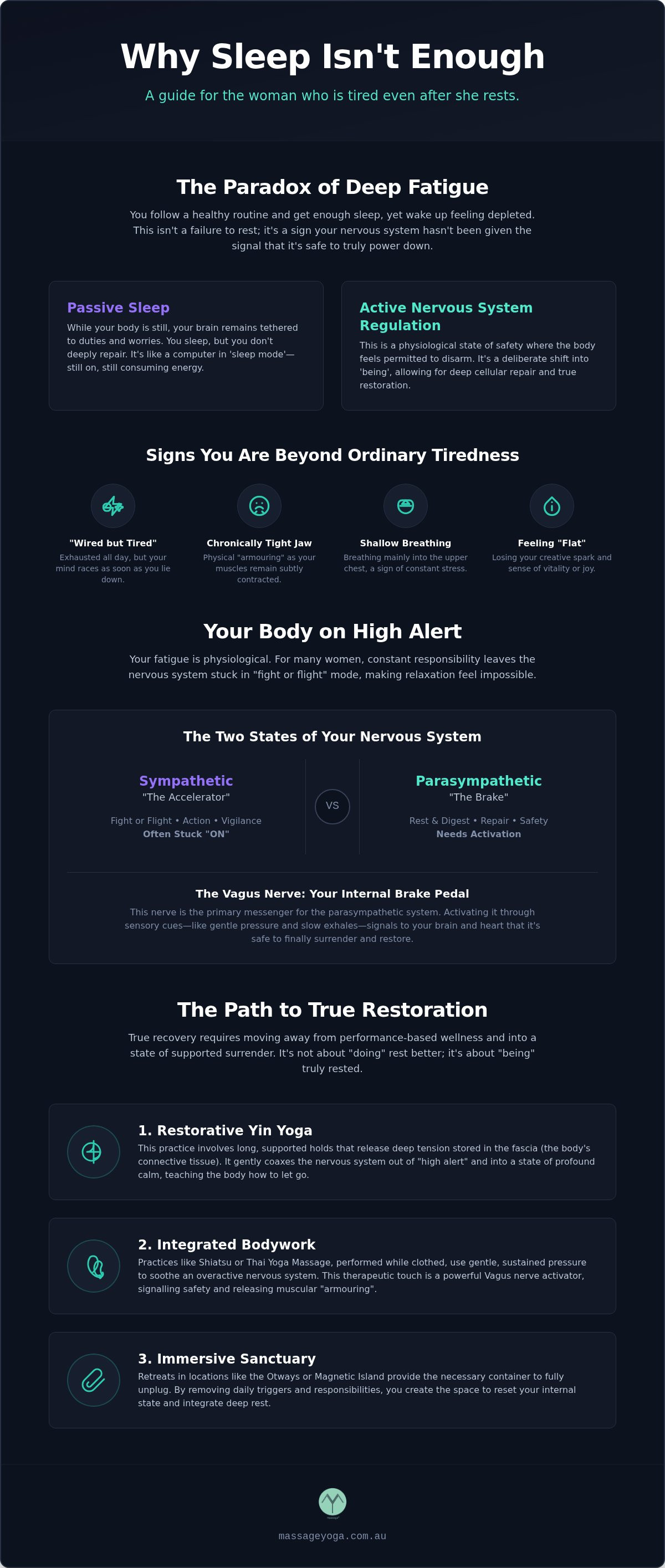
Imagine waking up after a full night’s sleep, yet feeling as though your body has been running a marathon while you were under the covers. This is the exhaustion that lingers in the bones. It isn't just about a lack of sleep; it's a profound central nervous system fatigue that occurs when your internal "on" switch is stuck in the active position. For many, the heavy weight of responsibility creates a permanent state of vigilance. If you find yourself searching for what to do if you are The Woman Who Is Tired Even After She Rests, it's essential to recognise that your weariness is valid and deeply physiological. You aren't failing at rest; your body simply hasn't been given the signal that it is safe to truly stop.

Restorative Stillness is a physiological state of safety where the body finally feels permitted to disarm and begin the work of deep cellular repair. Traditional sleep is often passive, but when you are carrying the mental load of an entire household or career, your brain stays tethered to those duties even in slumber. To find relief, we must move beyond passive sleep and into active nervous system regulation.

The Myth of Productive Self-Care

You might notice you are "wired but tired." You're exhausted all day, but as soon as your head hits the pillow, your mind begins to race with the day’s loose ends. This isn't just mental clutter; it is your body’s way of saying it doesn't know how to power down. Common physical cues include a chronically tight jaw, shallow breathing into the upper chest, and a sense of feeling "flat" or losing your creative spark. Understanding these signs is the first step in knowing what to do if you are The Woman Who Is Tired Even After She Rests. You aren't just tired; you are depleted at a nervous system level, requiring a different kind of care than a simple early night can provide.

Your Nervous System on "High Alert": The Science of Permanent Fatigue

Your body operates through a delicate balance of two primary states: the sympathetic and the parasympathetic. The sympathetic system is your accelerator, designed for action and "fight or flight." Conversely, the parasympathetic system acts as your internal brake, facilitating "rest and digest." For many, the modern world demands a constant state of readiness. This persistent pressure often leaves the "Woman Who Is Tired" stuck in a sympathetic dominant state. Even while you sleep, your brain remains vigilant, scanning for the next responsibility or threat. Understanding Fatigue in Women involves recognising that this isn't just a lack of willpower; it is a physiological entrapment in a state of stress.

When you are stuck in this loop, your body begins to "armour" itself. This is a subtle, constant contraction of the muscles, particularly in the jaw, shoulders, and pelvic floor. This armouring makes it physically impossible for your muscles to truly let go, even when you are horizontal. To unlock this state, we must engage the Vagus nerve, the longest cranial nerve in the body. It acts as the primary messenger for the parasympathetic system, signalling the brain and heart that the environment is safe enough to surrender. If you are searching for what to do if you are The Woman Who Is Tired Even After She Rests, it's essential to begin with this internal shift.

The Vagus Nerve and Deep Restoration

Activating the Vagus nerve requires more than just sitting still. It responds to specific sensory cues that bypass the analytical mind. Gentle pressure on the skin, the rhythm of a slow exhale, and soothing sounds all serve as invitations for the system to soften. High-intensity exercise, while beneficial for some, can often exacerbate burnout by keeping the sympathetic system firing. In contrast, restorative practices prioritise stillness and sensory safety to engage the parasympathetic brake. If you are exploring what to do if you are The Woman Who Is Tired Even After She Rests, the answer often lies in these quiet, sensory-rich moments of immersion.

Hormonal Havoc: When Rest Can’t Reach Your Adrenals

Chronic stress creates a dependency on cortisol, a hormone that provides a false sense of energy. Cortisol masks your true level of depletion, allowing you to push through your day until you eventually "crash." Your body requires explicit permission to stop this hormonal production. Deep, supported rest is the only way to signal to your adrenals that the "emergency" is over. By prioritising this level of recovery, you support long-term hormonal balance and allow your internal systems to return to a state of equilibrium. This shift is vital for moving from a life of survival into a life of spacious presence. To explore dedicated environments that facilitate this type of profound reset, you can learn more about SoulfulWaves and their approach to deep restoration.

Being the person everyone depends on is a heavy mantle to wear. It is a quiet, persistent weight that stays with you long after the day's tasks are finished. This "Carer’s Fatigue" is a unique form of depletion; it is the exhaustion that comes from holding emotional space for children, partners, and colleagues while neglecting your own internal landscape. If you are wondering what to do if you are The Woman Who Is Tired Even After She Rests, the first step is recognising that your energy is a finite resource. You cannot pour from an empty vessel. We have explored the 5 empowering steps if you are The Woman Everyone Depends On to help you navigate this transition. It requires radical boundaries and a shift in perspective from "guilty rest" to "essential restoration." Knowing what to do if you are The Woman Who Is Tired Even After She Rests often starts with the simple act of saying no to more demands.

When you prioritise your own nervous system, you aren't being selfish. You are ensuring you have the capacity to remain present and loving for those who matter most. Restoration is a gift you give to yourself and, by extension, to everyone you care for.

Teaching Your Body to Switch Off

Your brain needs a clear signal that the "doing" part of the day has concluded. For many, the transition from a hectic arvo to the evening is blurred by screens and lingering chores. Non-sleep deep rest (NSDR) is a game-changer in this space. Unlike sleep, which can be elusive when the mind is racing, NSDR involves guided stillness that allows the brain to enter a restorative state while remaining conscious. It's a way of clearing the "cache" of your mind. Establishing a simple evening ritual, such as dimming the lights or focusing on a slow, rhythmic breath, acts as a sensory cue. It tells your system that the world is handled and it's time to soften.

The Art of Saying "No" to Performance Wellness

In our effort to be healthy, we often fall into the trap of performance wellness. We push ourselves through a sweaty Vinyasa class or a high-intensity workout even when our adrenals are screaming for peace. If you are already depleted, more "effort" is not the answer. Sometimes, the most courageous thing you can do is skip the gym and choose stillness instead. Less is truly more when your system is on the brink of burnout. Find a "soft exhale" in your schedule, even for just five minutes. Intentional, quiet presence can do more for your hormonal health than an hour of forced movement. Give yourself permission to choose the path of least resistance.

What to do if you are The Woman Who Is Tired Even After She Rests

Restorative Yin Yoga and Massage: The Integrated Path to Relief

Most wellness routines are designed for the person with energy to burn. When you are truly exhausted, even a gentle Vinyasa class can feel like an assault on your senses. Massoga® was created as the antidote to this performance-based culture. By integrating the long, quiet holds of Yin yoga with the therapeutic power of massage, we create a bridge between physical release and mental stillness. This integrated bodywork provides the sensory "safety" your brain needs to stop scanning for threats. If you are searching for what to do if you are The Woman Who Is Tired Even After She Rests, the shift begins when you stop doing and start receiving. You can explore how Massoga® combines Yin Yoga and Massage for deep relief through our specialised private treatments.

What to do if you are The Woman Who Is Tired Even After She Rests involves moving away from group fitness and into a sacred, private space. In a world that demands you are "always on," being held in a supportive posture while receiving intentional touch allows your brain to finally disarm. It is a profound transition from the noise of daily life into a state of deep presence and surrender.

Why Stillness is Hard (and Why You Need Support)

Sitting in silence can be confronting when your internal world is chaotic. When you are depleted, your mind may race as a defence mechanism, trying to solve problems to keep you safe. This is where the practitioner’s touch becomes vital. A gentle, grounding hand on the shoulder or feet acts as a sensory anchor. It pulls an anxious system back into the present moment. Our trauma-sensitive approach ensures that every movement and touch is invited, creating a sanctuary where you can finally let go of the need to be "fine" for everyone else. You aren't just resting; you are being supported in your surrender.

The Fascia Connection: Releasing Physical "Memory" of Stress

Fascia is the intricate web of connective tissue that wraps around every muscle and organ. Under chronic emotional load, this tissue "tightens" and dehydrates, effectively locking stress into your physical form. This is why you feel heavy, restricted, and perpetually drained. Long-held Yin poses, supported by bolsters and blankets, allow this tissue to slowly hydrate and release. As the fascia softens, the physical memory of stress begins to dissolve. You walk away with a profound sensation of lightness and space, feeling as though you have finally returned home to your own body after a long absence.

Coming Home to Yourself: Luxury Retreats as a Reset Button

Sometimes, the only way to truly disarm is to leave the environment that keeps you in a state of vigilance. For the high-achieving woman, her home is often a map of responsibilities; every room contains a task, a memory of a chore, or a person who needs her attention. To find what to do if you are The Woman Who Is Tired Even After She Rests, you must physically step away from the triggers of your "always on" state. Immersive silence and the raw beauty of nature provide a sensory reset that a simple weekend at home cannot replicate. Whether it is the ancient, grounding forests of the Victorian Otways or the sun-drenched stillness of North Queensland, these landscapes act as a mirror for your internal state, inviting you to finally soften. You can experience this profound shift at our Yin Yoga Retreat Magnetic Island: A Luxury Sanctuary of Deep Rest.

When you arrive in these sacred spaces, the heavy mantle of responsibility begins to slide away. You are no longer the one who organises, manages, or cares for everyone else. You are finally the one who is cared for. This permission to be held in a state of deep presence is the ultimate luxury, allowing your nervous system to move from survival into a state of true surrender.

For women seeking a deep connection with nature, the woodland-based retreats at Sati offer a unique sanctuary where acoustic sound baths and wood-fired saunas facilitate this vital shift from survival to surrender.

Creating a Sanctuary of Rest

A holiday often involves planning, navigating, and "doing," which can leave you more depleted than when you left. A Massoga® retreat is fundamentally different. Every detail, from the restorative nourishment to the rhythm of movement, is thoughtfully curated to support your nervous system regulation. We move away from the fast pace of the world and into a slow, intentional cadence. In this sanctuary, you are invited to let go of the "busy mind" and go straight to the body. It is the bridge to Deep Rest here.

Taking the "Retreat State" Home

The true value of a retreat lies in the clarity you bring back to your daily life in Australia. You learn to recognise the subtle signs of physical "armouring" before they become permanent. Integration is a slow process of prioritising your own well-being as a non-negotiable part of your schedule. Regular One on One Massoga® Treatments serve as a vital "top-up" for your nervous system, ensuring that the spaciousness you found in nature isn't lost to the busyness of the week. Remember, you cannot pour from an empty cup. Your rest is not a reward for your hard work; it is the foundation that makes your life possible. Knowing what to do if you are The Woman Who Is Tired Even After She Rests begins with the radical choice to put your own recovery first.

Your Transition to Deep Presence and Surrender

You have spent years holding space for everyone else, often at the expense of your own internal quiet and vitality. True recovery begins when you recognise that your fatigue isn't a failure of willpower; it is a physiological sign that your nervous system is seeking safety. By shifting from passive sleep to active restoration through integrated bodywork and immersive retreats, you allow your body to finally disarm and begin deep cellular repair. This is what to do if you are The Woman Who Is Tired Even After She Rests: prioritise the profound stillness that your adrenals and your heart have been craving.

Under the founder-led expertise of Wallis Murphy-Munn, Massoga® offers a sacred sanctuary where you are no longer the one in charge. Our trauma-sensitive specialists provide private, integrated bodywork in exclusive luxury locations across Australia and Europe, ensuring you feel seen and supported throughout your transition into rest. You deserve to feel spacious and light in your own skin again.

Take a deep breath and allow yourself to soften. The journey home to yourself is waiting.

Frequently Asked Questions

Why am I still tired after sleeping 8 or 9 hours?

You are likely experiencing a state where your nervous system remains on "high alert" even while you sleep. This prevents you from entering the deep parasympathetic state required for true restoration. Sleep is a passive act, but recovery is an active state of nervous system regulation. Understanding what to do if you are The Woman Who Is Tired Even After She Rests involves learning how to signal safety to your brain and heart.

Is it normal to feel exhausted after a relaxing holiday?

It is very common for the body to "crash" once the pressure of daily life is removed. This happens because your stress hormones, like cortisol, finally begin to drop, revealing the true level of your exhaustion. A standard holiday often lacks the intentional support needed to regulate a dysregulated system. A structured retreat provides a sanctuary where you can safely navigate this "let-down effect" through integrated bodywork and immersive silence.

How can I tell the difference between ordinary tiredness and burnout?

Ordinary tiredness is usually fixed by a weekend of sleep. Burnout, however, is a deeper physiological depletion that leaves you feeling "wired but tired" at night and heavy during the day. You might notice physical cues like a tight jaw and emotional flatness. If you are searching for what to do if you are The Woman Who Is Tired Even After She Rests, recognise that burnout requires a nervous system reset rather than just more hours in bed.

What is the best type of yoga for someone who is permanently exhausted?

Restorative Yin yoga is the ideal choice for those facing persistent fatigue. It explicitly moves away from the fast pace of traditional Vinyasa flow, focusing instead on long, supported holds. These postures allow the fascia to hydrate and release without requiring physical effort. At Massoga®, we integrate this practice with massage to create a profound sense of safety, allowing the brain to finally disarm and the body to soften into a state of presence.

Can massage actually help with chronic fatigue and stress?

Yes, massage is a powerful tool for activating the parasympathetic "rest and digest" state. Intentional touch provides the sensory safety the brain needs to lower the heart rate and stop producing stress hormones. Our integrated bodywork approach combines massage with Yin yoga to bypass the analytical mind. This helps to release the physical memory of stress stored in your connective tissues, leaving you with a sense of lightness and a more spacious internal state.

How long does it take to regulate a dysregulated nervous system?

Nervous system regulation is an intentional journey, not a rapid event. While a single private treatment offers immediate relief, creating a new baseline of calm often takes time and consistency. Immersive retreats, such as those we host in the Otways or on Magnetic Island, provide a concentrated reset over several days. This allows your system to deeply unplug from triggers and begin the process of building long-term resilience and a sense of internal safety.

What are some simple ways to switch off my "fight or flight" mode at home?

You can begin by creating a sensory sanctuary in your own home. Dim the lights, prioritise silence, and practise a slow, rhythmic exhale to engage the Vagus nerve. Supported postures using bolsters or blankets can also signal to your body that it is safe to let go. If you find it difficult to transition alone, our Massoga® at Home service provides professional support to help you move from the "doing" day into a restorative evening.

Is a luxury yoga retreat worth it for burnout recovery?

A luxury retreat is a significant investment in your long-term health. It provides a necessary change of environment, removing you from the map of responsibilities that keeps you in a state of vigilance. In places like North Queensland or the Victorian Otways, every detail is curated to support your recovery. This immersive experience allows you to give yourself permission to be the one who is cared for, facilitating a deep and lasting nervous system reset.


Comments


Written by Wallis Murphy-Munn

Wallis Murphy-Munn is the founder of Massoga®, a unique practice that combines the therapeutic benefits of massage with the restorative elements of Yin Yoga.


Her hands-on teaching approach has led to deeper relaxation for her students, inspiring the creation of Massoga®.


In addition to her practice, Wallis enjoys writing blog articles to share her insights, advocating for the importance of human touch and simple connections in an increasingly isolated world.

14.png

About

Yoga Retreats

Other Services 

  • Instagram
  • Facebook
  • LinkedIn

We acknowledge the traditional owners of the land in all the regions of the beautiful countries we travel to and experience on retreat. The custodians of Kulin Nation, in the regions of the Woiworung, Boonwurrung and Wathaurong People. The custodians of the Yunbenun of the Wulgurukaba People. We acknowledge their Ancestors past, present and future who nurtured and cared for Country for tens of thousands of years.

© 2025 Massoga® Massage Yoga | Website by Insight Culture

bottom of page